Recall - glass particles
Hospira have recalled two injection products due to a defect in the primary container leading to a risk of glass particles within the solution. There are a number of issues to think about here with regards to QP study. Firstly was the AQL sampling of the primary containers at a suitable level? What type of glass is used (type 1/2?) A new component supplier? Automated inspections for particles & ampoule integrity will not detect these types of defects. This is also a good example of considering the extent of the defect as clearly the same primary containers are used for more than 1 product. What would you response be to this - increased AQL sampling? For cause audit? Additional QC testing on container receipt?
Safety Reporting requirements of new CT Regulation
A good article highlight the proposed changes to the safety reporting requirements for investigators & sponsors.
Medical Device EU Safety Update
The EC has introduced two new safety measures for medical devices. The new rules are focused on the notified bodies with regards to their auditing & assessment of manufacturers and clarifying the criteria these NBs need to meet.
FDA 483 for Indian API site
An interesting 483 report highlighting the deficiencies of an Indian API site. For each audit observation it is good practice to talk through how you would take these findings forward if you were auditing this site as an API supplier of your finished product.
PV Black Triangle video
The EMA have published a patient-focused video describing the introduction of the black triangle system for medicines subjected to intensive PV monitoring.
Update to EU-Japan MRA
The EMA has updated the MRA with Japan to permit the sharing of GMP data between manufacturers. This means that the Japanese regulatory authority can accept reference to the EudraGMDP certificates.
Sterilisation & Disinfection Standards
A comprehensive list of all standards relating to sterilisation & disinfection. A useful reference.
Doxil Drug Shortages
Yet more fall out from the ongoing issues surrounding J&J's Ben Venue facility in the USA. A good reminder of the requirement for MAHs to inform the competent authority in all markets when drug shortages are expected. Something to consider during your recall scenarios.
Hospira Recall - Particle contamination
A recall of a sterile injection due to a report of a dark particulate contaminant. This has been identified as oxidized stainless steel. What would be the likely source? 100% inspection performed manually or via automatic camera detector - one of the methods failed in this case.
Changing manufacturing facilities
Following the ongoing issues Ranbaxy is having with their existing sites in India the company is looking at purchasing a new site and transferring production. This is a good example of a common scenario question of a change in supplier or site. As a QP what would you need to see before manufacturing at the new site is started? A change control would be a good starting point.....
EMA PV signals
The EMA have begun publishing PV signals reviewed by the PRAC.
Malaria Vaccine
GSK look set to apply to the EMA for approval of their malarial vaccine during 2014. It is not clear if this product is to be manufactured within GSK's new Ulverston site.
Happy Reading!
Showing posts with label training. Show all posts
Showing posts with label training. Show all posts
Saturday, 12 October 2013

Friday, 16 August 2013
Friday's Round Up
The Buccal Route
I came across this paper this week and, although fairly old, it still provides a good overview of the buccal route for systemic drug absorption. All relevant stuff for your formulation & medicinal chemistry modules.
Yet another FDA 483 for compounders
Following on from previous 483s for drug compounders, Speciality Compounding were inspected in March this year and this only came to my attention following their product recall last week. The FDA are now taking some flak for the delay between the 483 and issuing the recall. This 483 should be useful for solid dose trainees as an introduction to poor sterile manufacturing practice.
Patch in a Can
An interesting new development in transdermal drug delivery.
Biobetters Vs Biosimilars
Teva has announced new EU drug approvals for 'biobetters' which apparently improves on the original innovator product on which this new product is based.
South Africa MRA on the Horizon?
Legislative changes in South Africa may provide the potential for future MRAs with EU and FDA
Counterfeit seizure in Ukraine
A large counterfeiting operation has been uncovered in Ukraine.
EMA Paper on Nanotechnology coating
Novel Endotoxin testing
Something new to me this week following some revision of the standard endotoxin tests. This test method is based on bacteriophage binding to LPS and removes the requirement for LAL.
Revised PDA technical report
An updated revision of the PDA's technical report into dry heat sterilisation & depyrogenation methods.
P&G recall
Although for dog food these recalls can still provide useful scenario questions. In this case, what is the potential sources of salmonella, clinical impact of salmonella, microbiology of salmonella etc
Happy reading!
I came across this paper this week and, although fairly old, it still provides a good overview of the buccal route for systemic drug absorption. All relevant stuff for your formulation & medicinal chemistry modules.
Yet another FDA 483 for compounders
Following on from previous 483s for drug compounders, Speciality Compounding were inspected in March this year and this only came to my attention following their product recall last week. The FDA are now taking some flak for the delay between the 483 and issuing the recall. This 483 should be useful for solid dose trainees as an introduction to poor sterile manufacturing practice.
Patch in a Can
An interesting new development in transdermal drug delivery.
Biobetters Vs Biosimilars
Teva has announced new EU drug approvals for 'biobetters' which apparently improves on the original innovator product on which this new product is based.
South Africa MRA on the Horizon?
Legislative changes in South Africa may provide the potential for future MRAs with EU and FDA
Counterfeit seizure in Ukraine
A large counterfeiting operation has been uncovered in Ukraine.
EMA Paper on Nanotechnology coating
Novel Endotoxin testing
Something new to me this week following some revision of the standard endotoxin tests. This test method is based on bacteriophage binding to LPS and removes the requirement for LAL.
Revised PDA technical report
An updated revision of the PDA's technical report into dry heat sterilisation & depyrogenation methods.
P&G recall
Although for dog food these recalls can still provide useful scenario questions. In this case, what is the potential sources of salmonella, clinical impact of salmonella, microbiology of salmonella etc
Happy reading!
Thursday, 1 August 2013
Study Toolbox Part 6: Teleconferences
 Throughout my QP training process teleconferences have been a regular and enjoyable way to assess my knowledge and progress towards submission.
1 to 1 teleconferences
The secret behind arranging teleconferences is your ability to network within your peers. Networking via training courses, conferences, social media and within your company is key to identify potential candidates to arrange teleconferences with. The ideal candidate will be one who is at a similar stage in their QP training and works in an area different from your own. Your sponsor should be able to provide you with potential contacts to get you started.
1 to 1 teleconferences give you the ability to dictate what topics are discussed and will provide less nervousness if giving incorrect answers. My weekly chat is with a trainee QP from 'big pharma' who specialises in solid dose manufacture. As my background is small scale sterile IMP manufacturing the contrasts are apparent and I certainly have gained great detailed knowledge into solid dose manufacturing just from these 30minute weekly sessions. A common theme for the discussions is to talk through lists of previous viva questions & scenarios. This provides a good insight into each other's thought processes and techniques in dealing with scenarios. This arrangement came about after a chance meeting at a PQG seminar last year. Therefore don't be afraid to approach people even if your introverted tendencies maybe telling you otherwise.
Multi person teleconferences
 Multi person teleconferences are obviously harder to arrange. If your network is large enough then this should not be too difficult to arrange yourself using popular teleconference software such as PowWowNow & free conference call. With an increase in numbers comes an increase in opinions and diversity of relevant topics. Occasionally you may have to listen to discussions surrounding topics that are not relevant to you. Multi person teleconferences can be more intimidating especially if you are a new addition to the regulars and you don't want to come across as a complete fool! Often you will find someone who 'chairs' the conference call to ensure all callers are included in the discussions and know when to move onto a different topic. Knowing that there are multiple callers means you can take a backseat to absorb what is being discussed without having to do any preparation before hand. This is useful for the initial few calls but to gain the most out of teleconferences you have to get involved and put your thoughts across. You really do get out what you put in.
There are a few established teleconferences that occur regularly throughout the working week. Alex at QPQuandary arranges 2 calls per week on Mondays and Fridays and often attracts wide range of callers most weeks. This is coupled to an extensive email network that provides a good forum for requests and follow up discussion if particularly interesting points are raised during the call. For me these have been an essential part to my QP training because the majority of callers are from commercial pharma so I can gain valuable information into the way commerical trainees handle scenarios and issues relevant to their practice. Over time I have manage to contribute from alternative angles (eg NHS, small scale IMP manufacturing) which hopefully has increased the awareness of other areas of practice for callers.
Summary
Teleconferences, either 1 to 1 or multiple person, can offer a great forum for discussion surrounding new GMP updates, scenarios or just to hear someone else's point of view other than your sponsor! In this age of email communication don't forget the faithful old telephone still has a huge part to play in your QP training journey.
Study Toolbox Part 1: The Onion
Study Toolbox Part 2: Introduction to Mindmaps
Study Toolbox Part 3: Keeping up to date
Study Toolbox Part 4: Training Courses
Study Toolbox Part 5: Visits
Friday, 24 May 2013
The Rise of Orphan Drugs
 Approvals for Orphan drugs have been on the increase within both the USA and
EU ever since legislation was introduced in an attempt to stimulate research
into rare diseases. The 1983 Orphan Drug Act and EU Regulation 141/2000
provided a new product class to which pharmaceutical companies can apply for
marketing authorisations. Both the EMA and FDA has seen a sustained
increase in applications. Approximately 30% of all applications for new
molecular entities within the USA are for Orphan drugs and the EMA has seen a
40% increase over the past few years.
Approvals for Orphan drugs have been on the increase within both the USA and
EU ever since legislation was introduced in an attempt to stimulate research
into rare diseases. The 1983 Orphan Drug Act and EU Regulation 141/2000
provided a new product class to which pharmaceutical companies can apply for
marketing authorisations. Both the EMA and FDA has seen a sustained
increase in applications. Approximately 30% of all applications for new
molecular entities within the USA are for Orphan drugs and the EMA has seen a
40% increase over the past few years.What is an Orphan Drug?
For a drug to be classified as an orphan drug the disease it is being used to treat must be designated an orphan disease. Within the EU an orphan disease is one which affects less than 1 in 2000 patients per year and this disease must be registered with the EMA in order to gain orphan status. This application (or sponsorship) is submitted by a corporate body, an individual researcher or a combination of both. The sponsorship details both the orphan disease and a proposed treatment and once granted by the committee of orphan medicinal products (COMP) the sponsorship lasts for 10 years. Within that 10 year period is it normally assumed that an application for a marketing authorisation will be submitted. Interestingly only the holder of the orphan designation (sponsorship) can be named as the MA holder on the MAA for the treatment specified within the orphan designation. An example of an orphan designation can be found here.
There are also a number of incentives available for pharmaceutical companies to invest in the development of orphan drugs. These include tax relief, reduced MA application fees and most importantly product exclusivity for 10 years. Many of these drugs, such as enzyme replacement therapies are designed to be a chronic treatment thereby requiring the patient to be treated for life. This will obviously help companies offset the reduced size of the target population.
With England the frequently quoted limit for new treatments to obtain NICE approval was typically £30k per patient per year. With Orphan drugs there is no such limit as QALYs and the other pharmacoeconomic tools are harder to relate to rare diseases. Cerezyme is a good example of this. Within England the cost per patient per year is ~£140k. In the States orphan treatments are now approaching $1m per patient per year for gene therapy drug Glybera.
Prior to the relevant orphan drug legislation there was little incentives for pharmaceutical companies to invest into treatments for rare diseases. The traditional search for the next ‘blockbuster’ drug helped to drive the pharmaceutical industry into hunting for larger and larger markets such as cardiology and infectious diseases. The shift away from blockbuster treatments to more personalised therapies has enabled clinical trials to be performed more efficiently by reducing subject numbers and stratifying trial subjects to known responders. Clinical trials for orphan drugs may include as few as 10-20 patients and this will often form part of the marketing authorisation application.
An MA to match
As the number of clinical trial subject can be very low the EMA can issue a conditional or exceptional circumstance MA for orphan drugs. A conditional MA is issued on the basis that a full dossier will be submitted in the future covering long term safety & efficacy data. Once submitted and approved the conditional MA then reverts to the traditional MA model. Exceptional circumstance Mas are issued when a full dossier is unlikely to be issued in the future due to the small patient numbers involved. The MA therefore becomes conditional on the MA holder performing long term safety studies and an annual assessment by the COMP. The legal basis for exceptional circumstance MA is EU regulation 726/2004 and the EMA website provides a good overview. The exceptional circumstance MA can therefore allow pharmaceutical companies to get their novel product to market sooner and without the costs associated with large phase 2 and 3 clinical trials. It must be noted that the three pillars of marketing authorisations (safety, quality & efficacy) still apply to both conditional and exceptional circumstance MAs.
Summary
The rise in marketing applications for orphan drugs can be attributed to a number of factors such as legislative developments, business incentives and the advancement of new technologies within the pharmaceutical industry. From a trainee QP’s perspective this post does not offer a great deal of information to help with your viva. However, being aware of how the pharmaceutical industry is changing is important to show an awareness of the bigger picture.
The exceptional circumstance and conditional marketing authorisations would provide an additional layer to your law and admin knowledge.
Saturday, 11 May 2013
The Application Form
One of the most important pieces of the QP training jigsaw is the QP application form. This and the Sponsor's form provide the professional body with documented evidence of the candidate's experience and is the first part of the assessment process. The aim of the application form is to show the assessors that you have covered all the relevant knowledge & experience you need to act as a QP. The assessors will compare your application form to the study guide to ensure all the requirements have been met.
The QP application form is analogous to a job application. The application form is used to show you have the required skills and experience for the job and is primarily used to get you an interview. The QP application should be treated in the same way - it is your ticket to being called for the viva. Therefore it should be thoroughly checked for omissions and errors before submitting. Your sponsor will play an important role here as they will need to countersign your application form. Guidance for completing the application form for both applicants & sponsors can be found here and is definitely worth a read before making a start on your form.
Tips for completing your QP application form
1. Start early
Ideally you should start competing your application form as soon as possible. Large sections of the application form cover personal details & employment history. Most of these data can be lifted straight from your CV. Even something as simple as this can take a lot of time so be prepared and plan your time effectively. You can then build your application form over time as you gain experience from work, visits or training courses.
My sponsor left his application form till the end of his training thinking it would not take long to complete. In the end it took him over 2 months to finish the application form! At this stage of your training you want to be spending all your effort on revising not completing your application form
2. GAP analysis
When populating your application form have the latest version of the study guide open. Perform a gap analysis of your current application form content verses the content required by the study guide. Your sponsor should be willing and able to do this for you. Once you know the areas that require further work you can tailor your training program to meet these objectives.
After my initial gap analysis I typed out all the missing sections in red. Once each section was completed I simply changed the font to black and moved on to the next section. Using a different colour font helped me to prioritise those sections of the study guide.
3. Be specific
After a while you can lose the will to live whilst completing the endless sections of the application form. It therefore becomes easy to write generic statements in an attempt to rush the process. The assessors reading your application form will be looking for details of what you actually did.
For example: which statement would best demonstrate to the assessor your knowledge on supplier audits?
- Perform supplier audits
- Performing a supplier audit on a media manufacturer who supplies my organisation. The audit included a review of the supplier's ISO9001 certified QMS, media manufacturing processes & facilities.
4. Know your dosage form
The contents of your application form will dictate some of the lines of questioning from the assessors. This will be particularly important when it comes to your specified dosage form. You obviously wont be expected to know every dosage form but you'd better know all the ones you put down on your form - especially those other dosage forms on your MIA license.
Summary
The application form is a critical part of your application process and will provide the assessor's a first impression of you and your potential to be a QP. Completing the form takes time and I would highly recommend starting as soon as possible.
Thanks to my sponsor for help with this article and for reviewing my own application form!
The QP application form is analogous to a job application. The application form is used to show you have the required skills and experience for the job and is primarily used to get you an interview. The QP application should be treated in the same way - it is your ticket to being called for the viva. Therefore it should be thoroughly checked for omissions and errors before submitting. Your sponsor will play an important role here as they will need to countersign your application form. Guidance for completing the application form for both applicants & sponsors can be found here and is definitely worth a read before making a start on your form.
Tips for completing your QP application form
1. Start early
Ideally you should start competing your application form as soon as possible. Large sections of the application form cover personal details & employment history. Most of these data can be lifted straight from your CV. Even something as simple as this can take a lot of time so be prepared and plan your time effectively. You can then build your application form over time as you gain experience from work, visits or training courses.
My sponsor left his application form till the end of his training thinking it would not take long to complete. In the end it took him over 2 months to finish the application form! At this stage of your training you want to be spending all your effort on revising not completing your application form
2. GAP analysis
When populating your application form have the latest version of the study guide open. Perform a gap analysis of your current application form content verses the content required by the study guide. Your sponsor should be willing and able to do this for you. Once you know the areas that require further work you can tailor your training program to meet these objectives.
After my initial gap analysis I typed out all the missing sections in red. Once each section was completed I simply changed the font to black and moved on to the next section. Using a different colour font helped me to prioritise those sections of the study guide.
3. Be specific
After a while you can lose the will to live whilst completing the endless sections of the application form. It therefore becomes easy to write generic statements in an attempt to rush the process. The assessors reading your application form will be looking for details of what you actually did.
For example: which statement would best demonstrate to the assessor your knowledge on supplier audits?
- Perform supplier audits
- Performing a supplier audit on a media manufacturer who supplies my organisation. The audit included a review of the supplier's ISO9001 certified QMS, media manufacturing processes & facilities.
4. Know your dosage form
The contents of your application form will dictate some of the lines of questioning from the assessors. This will be particularly important when it comes to your specified dosage form. You obviously wont be expected to know every dosage form but you'd better know all the ones you put down on your form - especially those other dosage forms on your MIA license.
Summary
The application form is a critical part of your application process and will provide the assessor's a first impression of you and your potential to be a QP. Completing the form takes time and I would highly recommend starting as soon as possible.
Thanks to my sponsor for help with this article and for reviewing my own application form!
Saturday, 4 May 2013
Study Toolbox Part 4: Training Courses
This 4th post in the Study Toolbox series will provide an overview of the training courses available to help you on your long road to eligibility.
One of my previous posts gave a brief overview of the QP Study Guide which provides a general syllabus that all prospective QPs are expected to have a detailed understanding of. There is a wealth of topics within the Study Guide and the breadth of topics can be overwhelming at first glance. This may be of particular relevance for trainee QPs from either small scale manufacturing operations (like me) or from those from relatively niche areas such as PET radiopharmaceutical or medical gas manufacture.
So how can you demonstrate you have the required knowledge & experience in all 11 sections of the Study Guide? The training providers listed below will provide this but they are not compulsory or expected to be on your application form.
Commercial Training Providers
Training courses are one way of gaining sufficient knowledge. The main commercial training providers offer modules based on each of the 11 sections of the Study Guide. These courses not only provide comprehensive training but also provide a fantastic opportunity for networking with other trainee QPs. This is especially important for identifying potential study partners and arranging reciprocal visits. (I'll aim to cover visits in a future post).
NSF-DBA
The David Begg Associates courses have been running for a number of years now and are viewed by many to be the gold standard with regards to QP training packages. The full course is linked with the University of Strathclyde and offers candidates the opportunity to gain a post graduate certificate, diploma or MSc. The modules run over 21 months but you can pick and choose the modules to fit in with your own requirements or knowledge gaps.
Each module lasts between 4 to 5 days in Durham or York Marriott hotel conference centres. Lecture notes for each module are substantial and include not only the slides but a very useful overview of each lecture in an easy to read format that compliments the slides really well. The week long course is broken up into lectures and practical group work. Written exams are held for those students aiming to complete the post graduate university course.
Is there a downside? At circa. £3-4k per module the cost my be prohibitive for some companies or individuals who are self-funding (like me). Also the length of the course means added expense of hotel & travel. DBA offer special rates for the Marriott hotel at circa. £100 per night and will obviously provide a great platform to continue the networking into the early hours!
DBA does offer a generous 50% discount for NHS employees which then brings it the price down in line with other providers. To qualify for the discount you'll need a confirmation letter from your employer and DBA will then invoice you with the discount included.
DBA also offer a free annual QP training day for prospective students and their sponsors. The date for this year is May 14th and I'll be heading up for the day. It might be worth contacting DBA directly to enquire for last minute availability.
RSSL
RSSL specialise in scientific analysis, consultancy, product development and training for the pharmaceutical and food sectors. Their popular QP training packages offer the similar layout to DBA by offering 11 stand alone modules the reflect the Study Guide. There is no university collaboration so post graduate qualifications are not available to run in parallel with the QP course.
RSSL has its advantages over DBA. The training is held within Reading and typically over 2 days meaning less impact to your work and family duties and may not require nights away from home for those based around London. The costs per module is more accessible at circa £1.5k. The shorter duration of the module means more of a focus on the relevant details required for your QP training. The notes are more succinct than DBA but do not provide the excellent text overview for each lecture.
One of my previous posts gave a brief overview of the QP Study Guide which provides a general syllabus that all prospective QPs are expected to have a detailed understanding of. There is a wealth of topics within the Study Guide and the breadth of topics can be overwhelming at first glance. This may be of particular relevance for trainee QPs from either small scale manufacturing operations (like me) or from those from relatively niche areas such as PET radiopharmaceutical or medical gas manufacture.
So how can you demonstrate you have the required knowledge & experience in all 11 sections of the Study Guide? The training providers listed below will provide this but they are not compulsory or expected to be on your application form.
Commercial Training Providers
Training courses are one way of gaining sufficient knowledge. The main commercial training providers offer modules based on each of the 11 sections of the Study Guide. These courses not only provide comprehensive training but also provide a fantastic opportunity for networking with other trainee QPs. This is especially important for identifying potential study partners and arranging reciprocal visits. (I'll aim to cover visits in a future post).
NSF-DBA
The David Begg Associates courses have been running for a number of years now and are viewed by many to be the gold standard with regards to QP training packages. The full course is linked with the University of Strathclyde and offers candidates the opportunity to gain a post graduate certificate, diploma or MSc. The modules run over 21 months but you can pick and choose the modules to fit in with your own requirements or knowledge gaps.
Each module lasts between 4 to 5 days in Durham or York Marriott hotel conference centres. Lecture notes for each module are substantial and include not only the slides but a very useful overview of each lecture in an easy to read format that compliments the slides really well. The week long course is broken up into lectures and practical group work. Written exams are held for those students aiming to complete the post graduate university course.
Is there a downside? At circa. £3-4k per module the cost my be prohibitive for some companies or individuals who are self-funding (like me). Also the length of the course means added expense of hotel & travel. DBA offer special rates for the Marriott hotel at circa. £100 per night and will obviously provide a great platform to continue the networking into the early hours!
DBA does offer a generous 50% discount for NHS employees which then brings it the price down in line with other providers. To qualify for the discount you'll need a confirmation letter from your employer and DBA will then invoice you with the discount included.
DBA also offer a free annual QP training day for prospective students and their sponsors. The date for this year is May 14th and I'll be heading up for the day. It might be worth contacting DBA directly to enquire for last minute availability.
RSSL
RSSL specialise in scientific analysis, consultancy, product development and training for the pharmaceutical and food sectors. Their popular QP training packages offer the similar layout to DBA by offering 11 stand alone modules the reflect the Study Guide. There is no university collaboration so post graduate qualifications are not available to run in parallel with the QP course.
RSSL has its advantages over DBA. The training is held within Reading and typically over 2 days meaning less impact to your work and family duties and may not require nights away from home for those based around London. The costs per module is more accessible at circa £1.5k. The shorter duration of the module means more of a focus on the relevant details required for your QP training. The notes are more succinct than DBA but do not provide the excellent text overview for each lecture.
Inspired Pharma
Inspired Pharma offer an alternative platform with their QP training. They provide online tutor-facilitated courses on the Study Guide topics. This allows you to fit the training in and around your busy work/life schedule without the need to spend 3-5 days on a residential course. There is not a great deal of information on their website regarding the costs of these courses but I would suggest emailing them for further information.
Pharmaceutical Quality Group
Although not strictly a QP training provider, the PQG is an invaluable source of information for trainee QPs. Membership is only £17 per year and this provides access to a wealth of documents and presentations available via their website. For trainee QPs the PQG provide QP seminars specifically aimed at trainees and newly qualified QPs. These full day seminars based in London provide a great introduction to QP training. They cover the application process, requirements and legislation/GMP update session.
My first foray into the QP training arena was attending last year's November seminar. I found it extremely useful and a great opportunity for networking with other trainee QPs from the pharmaceutical industry. I met a great study partner from this course and we still have weekly calls to discuss scenarios etc.
The PQG also arrange visits to a wide range of pharmaceutical manufacturing facilities, distributors, API manufacturers. The events page on their website gives all the visits coming up. These are particularly good value at around £60 per visit.
Non-Commercial Training Providers
Q3P (UCL School of Pharmacy)
This is the only non-commercial provider that I am aware of. The Q3P course was initially aimed at addressing the shortage of QPs within the NHS sector. The course is free for NHS staff and provides a similar layout to the commercial providers in following the Study Guide with 1 or 2 day modules. Although still in its infancy the course is now enrolling its 3rd cohort. The training has evolved since the first cohort and includes lecturers from both the pharmaceutical industry and NHS sectors as well as QP assessors.
The Q3P course has a free open day on the 6th June 2013 for prospective students. See their website for details.
Post Graduate University Courses
There are a number of university courses that cover some aspects of the Study Guide. Although not specifically tailored to QP training they do offer a good grounding in the essential elements of pharmaceutical manufacturing & quality assurance. These part time courses are designed on a modular basis and will provide the opportunity for post graduate qualifications to MSc level. Post graduate qualifications are available with the NSF-DBA course (see above).
PIAT (Manchester University)
Industrial Pharmaceutical Sciences (Brighton University)
Pharmaceutical Technology (Bradford University)
PTQA (Leeds University)
Leeds University has now stopped supporting the PTQA course and currently there is no further information on the future of the course.
Completion of these courses would usually be expected before gaining QP trainee positions. From there the QP trainee would often be sent on the specific commercial training courses to build on the knowledge from the post graduate course.
Individualised Mentoring & Training
All of the courses above will provide you with a great amount of knowledge covering all aspects of the Study Guide. However it must be noted that attendance to these course wont automatically get you through the viva. The knowledge gained wont provide you with the detail and expertise required to structure well reasoned responses to the viva questions.
This is where personalised training will help translate your knowledge into a well structured format to get you through the viva. They will also offer to review your application form and provide either face-to-face or telephone training sessions tailored to suit you and your specific requirements. The providers will also be well networked within the QP community and hence should be able to provide contacts for potential visits.
QPQuandary
This personalised training company provides coaching and mentoring to both QP trainees and sponsors. It is run by Alex Hall who provides teaching on some of the commercial training courses including RSSL & Q3P as well as one-to-one coaching.
Alex is the RSC Chief Assessor and senior QP for Roche, but will be running QPQuandary full time in the near future. Therefore she knows what it takes to get through the viva and can provide mock vivas, application form reviews and numerous other services to help meet your training needs. In addition she provides a fantastic weekly teleconference service for groups of QP trainees from a wide range of backgrounds. For more information see the QPQuandary website for her contact details.
Other Training Sources
Self Study
Your own personal study underpins everything you learn both from your job and attendance at training courses. There are no shortcuts. You will have to hit the books for hour after hour to ensure all the knowledge remains at the forefront of your mind especially leading up to viva day. Self study is acceptable for inclusion into your application form.
In House Training
Some of the larger companies (e.g. GSK) provide substantial in-house training programmes for trainee QPs that rival even the DBA course. For those with shallower pockets in house training can be provided by your sponsor or from subject matter experts within your company. This can be on a one-to-one basis or as part of departmental-wide training sessions.
My own training plan
My training is underpinned by a Pharmacy degree and post graduate diploma in the PTQA course. I've chosen a pick n' mix selection from the training providers in order to fill in the gaps. A gap analysis really helps identify those areas that need supplementing with training courses. I'll be using DBA for API manufacture, roles of QP and Law & Administration courses this year. Law & Admin and QP roles are essential as they form the majority of the fundamental modules of the Study Guide. API manufacture is not something I have exposure to from either work experience or from my previous training courses and hence is a significant knowledge gap for me. In addition to these I've booked a mock viva & mentoring sessions with QPQuandary as a milestone for me prior to submitting. I've also got into the habit of self study most evenings to supplement all the above.
Summary
There are a wide range of QP training courses available to cater for all your training requirements. They are not compulsory for getting to the viva but will provide you with the knowledge, networking and confidence in new subject areas. Supplementing these with one-to-one coaching sessions either from your sponsor or specialist training providers should provide the final polish for you before you enter the lions den.
I'm sure there are other providers out there. Please add any to the comments section below.
Study Toolbox Part 1: The Onion
Study Toolbox Part 2: Introduction to Mindmaps
Study Toolbox Part 3: Keeping up to date
Tuesday, 16 April 2013
Study Toolbox Part 3: Keeping up to date
The 3rd instalment in the Study Toolbox series will look into the best ways of keeping up to date with the ever-changing field of GMP and pharmaceutical legislation. This is important not only for your viva but also throughout your QP career. There is also a requirement for continuing professional development (CPD) once you become a member of one of the joint professional bodies. Therefore keeping up to date will also help maintain your CPD to keep your professional regulator happy!
One of the most commonly asked questions in the QP viva is regarding GMP updates. This question is usually asked towards the start of the viva in order to provide a 'soft' question to help settle your nerves and get you on track for the more meatier questions ahead. The question may be phrased open-ended, eg 'what are the recent GMP updates?' or 'What recent updates are relevant to the QP?' Specific questions are more likely to be asked as a follow up to one of your previous answers, eg 'you mentioned the FMD directive, please explain'. Therefore you will need to have a good overview of recent updates but also be able to have more layers/details for specific updates relevant to QPs.
Tools for keeping up to date
 1. RSS Feeds
 My main tool for monitoring updates is via RSS feeds. You'll need a RSS reader such as Google Reader to provide a viewable platform for the incoming feeds. RSS feeds are typically linked to websites and once the story is published the link gets sent straight to your reader. This provides a useful way of skimming through all your favourite websites without having to trawl through each website in turn. Most websites will have an orange RSS symbol within their news section. Clicking on this symbol will provide a direct link for your RSS reader.
Occasionally you will receive updates via RSS before the website has been updated. For example, the recent updates to the chapters within Eudralex Vol 4 is not (yet) listed on the Eudralex section of the ec.europa.eu website. Thanks to my RSS reader these updates found their way to me and can easily be retrieved by searching within my RSS reader. If you were only looking at the Eudralex website you may have missed these crucial updates to GMP.
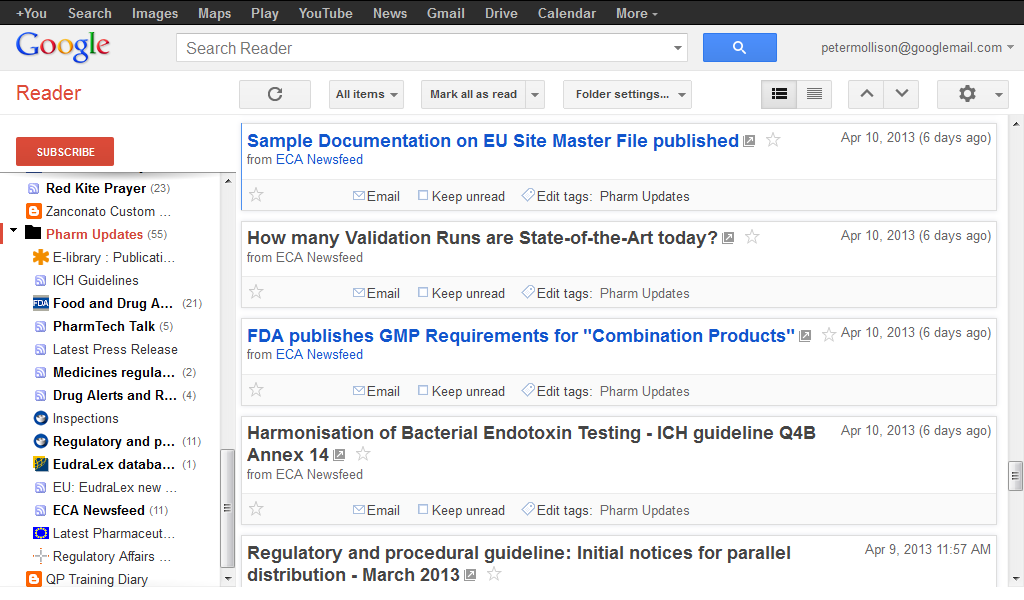 |
| Google Reader detailing my Pharmaceutical updates section |
Google reader is also available as a mobile app which allows you to sync your reader account to your smartphone/tablet for access during those long commutes on the train. Most RSS readers can also incorporate your favourite blogs which will send new posts to your reader as soon as they are published.
My top sources for RSS feeds:
MHRA
EMA
FDA
ICH
Eudralex (ec.europa.eu)
European Federation of Pharmaceutical Industries & Associations (EFPIA)
RAPS Regulatory Exchange
GMP Publishing
European Compliance Academy (ECA)
Pharma IQ
Royal Pharmaceutical Society
World Health Organisation
International Organisation for Standardisation (ISO)
2. Email Alerts
Email alerts are also a great way of keeping up to date. Most of the main players in the Pharmaceutical/GMP arena have email alerts you can sign up to. The emails can come flying in thick and fast and I would recommend setting up a dedicated email address for this if you don't want your regular inbox becoming inundating and messing up your hectic social life.
Signing up for the MHRA drug alert emails is particularly useful. Not only are the alerts emailed instantly but they are a really useful source for potential scenario-based questions and to get an good idea of what types of defects/errors make up the different types of drug alert classes. The FDA's warning letters (483) provide a great insight into serious GMP inspection findings for sites both within and outside the United States.
My top sources for Email alerts:
FDA
MHRA
European Compliance Academy (ECA)
3. Twitter
I am only a recent convert to Twitter but have found it useful for providing information and links to websites & articles that you may not have originally thought of. Twitter lends itself well to the mobile platforms due to the (mostly) text only interface.
Again, all the main culprits have twitter accounts such as MHRA, EMA, RPS etc but I tend to use Twitter for following specialist individuals as opposed to large organisations. These specialist individuals usually dont have the resources for setting up RSS feeds or comprehensive email alerts systems and hence I let my Google reader account take care of information from the large organisations. When you find someone to follow it is always worth looking to see who they are following themselves. This will likely increase your scope and identify further people/organisations to follow.
These are some of the useful active accounts I'm following:
@PharmaIQ
@QPQuandary
@AlecGaffney
@PharmaNews
@BioPharmIntl
@Inspiredpharma
@PharmTechGroup
@EURlex
3. Other Social Media & Journals
There are quite a few additional sources available to you. Facebook, journals, blogs, LinkedIn to name but a few. I tend not to rely on these for providing updates to relevant GMP/legislation/guidelines. I've found these sources to be more useful for general information, networking and job hunting!
I still like to occasionally browse some of the high impact journals surrounding subjects that I have a personal interest in. These include; Cancer Cell, Cell, Nature Cancer Reviews, Science & NEJM. These obviously wont keep you up to date with the latest GMP developments but will provide background knowledge to scientific progresses in disease states relevant to your particular dosage forms. This background knowledge may also help prepare you for what is to come in the future with regards to novel treatments - they'll all hopefully need QP certification one day!
Using MindMaps to manage updates
Throughout your QP training there will be a number of important updates that you will need to remember for your viva. Certainly in the last 6 months there has been enough GMP updates to keep us all busy. The QP assessors will likely expect you to not just list all the updates but provide detail on updates that are relevant to your current practice. With each new update you can amend your mindmap to reflect the changes and doing this as you go along should help reduce the burden once you get closer to viva day.
The image of my mindmap above shows the outline of all the relevant areas of updates that I feel I should be aware of. I haven't included FDA updates within my own map as my current area of practice does not include any drugs marketed in the USA.
As mentioned in my previous post mindmaps are a really useful tool for providing layers of details to particular subjects. GMP updates is a good example of making the most out of mindmaps. The image above has focused in on GMP updates and the first layer is detailing the relevant years. I doubt you'll be expected to know the explicit details of updates going back 5 years. I've only gone back to 2008 because this was the last major update of Annex 1 and Sterile products will be my specialist dosage form.
Summary
I am only a recent convert to Twitter but have found it useful for providing information and links to websites & articles that you may not have originally thought of. Twitter lends itself well to the mobile platforms due to the (mostly) text only interface.
Again, all the main culprits have twitter accounts such as MHRA, EMA, RPS etc but I tend to use Twitter for following specialist individuals as opposed to large organisations. These specialist individuals usually dont have the resources for setting up RSS feeds or comprehensive email alerts systems and hence I let my Google reader account take care of information from the large organisations. When you find someone to follow it is always worth looking to see who they are following themselves. This will likely increase your scope and identify further people/organisations to follow.
These are some of the useful active accounts I'm following:
@PharmaIQ
@QPQuandary
@AlecGaffney
@PharmaNews
@BioPharmIntl
@Inspiredpharma
@PharmTechGroup
@EURlex
3. Other Social Media & Journals
There are quite a few additional sources available to you. Facebook, journals, blogs, LinkedIn to name but a few. I tend not to rely on these for providing updates to relevant GMP/legislation/guidelines. I've found these sources to be more useful for general information, networking and job hunting!
I still like to occasionally browse some of the high impact journals surrounding subjects that I have a personal interest in. These include; Cancer Cell, Cell, Nature Cancer Reviews, Science & NEJM. These obviously wont keep you up to date with the latest GMP developments but will provide background knowledge to scientific progresses in disease states relevant to your particular dosage forms. This background knowledge may also help prepare you for what is to come in the future with regards to novel treatments - they'll all hopefully need QP certification one day!
Using MindMaps to manage updates
Throughout your QP training there will be a number of important updates that you will need to remember for your viva. Certainly in the last 6 months there has been enough GMP updates to keep us all busy. The QP assessors will likely expect you to not just list all the updates but provide detail on updates that are relevant to your current practice. With each new update you can amend your mindmap to reflect the changes and doing this as you go along should help reduce the burden once you get closer to viva day.
 |
| My constantly evolving updates Mindmap. |
The image of my mindmap above shows the outline of all the relevant areas of updates that I feel I should be aware of. I haven't included FDA updates within my own map as my current area of practice does not include any drugs marketed in the USA.
 |
| 2nd & 3rd layers of updates mindmap showing GMP updates. |
As mentioned in my previous post mindmaps are a really useful tool for providing layers of details to particular subjects. GMP updates is a good example of making the most out of mindmaps. The image above has focused in on GMP updates and the first layer is detailing the relevant years. I doubt you'll be expected to know the explicit details of updates going back 5 years. I've only gone back to 2008 because this was the last major update of Annex 1 and Sterile products will be my specialist dosage form.
 |
| 3rd, 4th & 5th layers of updates Mindmap for the chapter 5 update in 2013. The layering technique is hopefully clear from the image above. |
Summary
GMP & legislature updates are an important part for both your viva and for your future life as a QP. We are lucky to live in such an electronic age where all relevant updates can be immediately disseminated throughout the QP community.
Taking advantage of the available tools mentioned in the post should help these updates find you as opposed to you going out hunting for them.
Study Toolbox Part 1: The Onion
Study Toolbox Part 2: Introduction to Mindmaps
Friday, 12 April 2013
Roles of the Sponsor
 One of the most important people in the process of becoming a QP is your sponsor. Your sponsor should provide you with a wealth of knowledge & experience and a passion for their work. The sponsor is not just someone who signs your application form at the end of the process!
Sponsor Requirements
your sponsor must be a member of one of the 3 professional bodies (RPS, RSC, SoB) and should be a practising Qualified Person. In practice it is common that your sponsor will be your line manager. This is preferential as they will already know your previous experience and be regularly available for discussions and reviews. A line manager who is not a QP may act as your sponsor as long as the application form is counter-signed by a QP performing duties under the license to which you are engaged.
The role of the Sponsor should not be taken lightly as the role carries significant responsibility. The QP Guidance Notes issued by the joint professional bodies gives a comprehensive list of roles & responsibilities of the sponsor and is well worth a read for both QP trainees and sponsors alike.
Sponsor Form
The sponsor form will form part of your completed QP application package to your professional body. The QP sponsor form was comprehensively updated in 2013 to ensure sponsors are fully integrated into the trainee QP's training. The updated form also gives the sponsor more documentation to complete prior to submitting the trainee's application form. Sponsor's will have to provide examples of occasions where the trainee QP has met a number of competencies.
So, what should you look for in a potential sponsor? Here are some of my sponsor tips (in no particular order) from my limited experience with working with my own sponsor:
- Share an office
2. Allocate time
Allocate time for regular meetings each week. These should review your current training topics, application form, planned visits and work diary. Having some structure to these meetings helps to make use of the (usually limited) time available. Set objectives & goals for the next meeting to ensure you can target your study topics effectively. Making the meetings formal, for example by scheduling in Outlook is a great way of keeping the meetings.
3. No sugar coating
Your sponsor needs to be honest with you. If you answers to questions or knowledge around a specific area is lacking then they need to tell you. There is no point in pretending all will be fine come viva day as you'll need toughening up before meeting the 3 assessors in your viva. Obviously constructive criticism works best and the trainee needs to be receptive to this. Taking the mickey is acceptable if your answers are daft enough.....
4. Old school Vs New school
I think it really helps having a sponsor who has gone through the viva as they should know what it takes to train someone to pass. Grandad & transitional QPs have not gone through the viva process and, to me, would appear not to be in the best position to prepare someone for a viva they haven't sat before. Ensure your sponsor is up to date in all recent GMP/legislation updates as you will need to be tested regularly on this area as this is sure to come up in the viva.
5. Well networked
Your sponsor should be well networked within the QP community. I haven't met one that hasn't been well networked yet - even in the NHS! Having contacts is particularly important to help arrange industry visits to cover areas/dosage forms and provide introductions to other trainee QPs for potential study partners. It is important to create these networks yourself in order to get different opinions from your sponsor - your sponsor doesn't always know best! (only your mum does)
6. Involved in QP trainee recruitment
Having the sponsor directly involved with the recruitment process will ensure the applicant's understanding of the level of commitment required throughout the training period. As a sponsor you will also need to be able to communicate effectively with your trainee and being on the interview panel will provide an insight to the candidates personality.
7. Supportive
During your QP training you will have ups and downs. There will be times where your confidence soars around particular topics and other times where you feel you cannot see the woods for the trees. Having a supportive sponsor who knows how to recognise these signs will help you to get through the bad times and keep you grounded during the highs. They should also understand to recognise when you've had enough and need a break for a week or 2 as the training can quickly become all-consuming.
8. Prepared to be challenged
As the trainee gains knowledge and experience the sponsor should be expected to be challenged from time to time. The sponsor needs to encourage this to develop the debating skills in the trainee which will be needed not only in the viva but as performing their QP duties in the future.
9. Get the rounds in
You need to get along with your sponsor as you will likely be spending considerable time with them throughout your training. Having common interests outside of the GMP-world is beneficial and enjoying each other's company over a beer or 2 always helps.
10. Keep them sweet
When you finally pass your viva make sure you find a suitable way of thanking them (be creative). Don't piss them off and leave the company straight after gaining your QP status! That is likely to leave a sour taste in their mouth - remember, the QP world is small and well networked!!
I've been really lucky with my sponsor. We were friends before even starting the QP training and are of similar age which helps with the working relationship. More importantly, he has only recently passed the viva so all his knowledge is still lodged in his head (for now at least).
Tuesday, 9 April 2013
Study Toolbox Part 2: Intoduction to Mindmaps
Part 2 of the Study Toolbox series looks at the use of mindmaps to develop your knowledge and more importantly to hone your technique for delivering those perfect answers during the dreaded QP viva.
I had never heard of mindmaps prior to starting my QP training. It was my sponsor who introduced them to me (they do have their uses) and I have now incorporated them into my daily study schedule.
What are Mindmaps?
 As usual, Wiki provides a great overview of the basics of Mindmaps. Mindmaps are diagrams used to visualise all links, ideas, words & concepts around a central, single topic (think brainstorming). They can be handwritten or designed with dedicated software. They are particularly useful for problem solving & condensing information into layers (remember the onion analogy?) - two attributes that lend themselves to QP training.
Manual Mindmaps
I've found that manual Mindmaps are useful for outlining all the branches & layers surrounding a particular topic or question before transferring to a final electronic copy. Mindmaps give you and your brain the freedom from the 'fit on the page' mentality as mindmaps can go on and on forever and link with other mindmaps to create a multitude of maps to really free your mind. Obviously the electronic versions are really only capable of this, unless you have an abundance of A1 paper laying about the office.
Electronic Mindmaps
There are a number of software providers willing to take your hard earned cash for their software. Luckily, if you are a skinflint like me, there are a few free versions out there and most provide a free trial which if you are clever, can 'extend' unofficially. Ive tried a few different programmes and here are my thoughts:
1. Mindjet
This is my go-to software for generating mindmaps. Mindjet offers a cloud based portal for electronic storage of your mindmaps. This is great if you like having access to your mindmaps from any PC and are wary of your laptop crashing and loosing the data forever. For those willing to pay the annual subscription, Mindjet gives you the option to export to .pdf or .doc etc to provide an off-line back up system. Your PC will need Flash installed to view the mindmaps.
After 6 months of use Mindjet has grown on me. The convenience of cloud storage, no limit to the free trial and expandable/collapsible branches are particularly useful to me. The expandable/collapsible branches helps in preparing responses to your viva questions - I'll post on this separately soon. The advantages outweigh the sometimes clunky interface which can occasionally crash causing loss of data. However, this has only happened twice in my time using it.
I have also found a way to edit off-line using Mindjet. The Mindjet android app allows you to edit or create mindmaps off-line and once back on-line the app will sync with your mindjet account. Accessing your mindmaps from the convenience of a tablet computer or smartphone is very convenient and would highly recommend it especially for those who commute by public transport.
This is my sponsor's mindmap of choice. iMindmap offers the option of desktop and cloud storage of mindmaps as well as free 7 day trial before you commit. It functions as per the usual mapping software but allows you to drag topics from the central theme using the mouse. The free version does not allow you to collapse or expand branches - this is where Mindjet has the advantage. One of its selling points is that it has been developed by one of the founders of mindmaps (Tony Buzan) and it uses bright colours in default setting to really get both sides of your brain firing.
The only reason I didnt continue with iMindMap was due to the lack of the collapsible/expandable branches on the free version and the 7 day trial limit.
3. MindMeister
I only tried this free android tablet app for a few minutes before its annoying user interface and lack of undo function drove me to hit the uninstall button. From my experience there are far better mindmapping software out there.
Mindjet Example
The example below is from my own bank of Mindjet mindmaps. The map contains basic lists to learn for the microbiology module. I've zoomed in on Rapid Methods to show how I have constructed the map to provide an overview (3 subtopics) and further layers with increasing detail - again picture those onion layers.
 | |||
|
 |
| 1st layer from sub-topic |
 |
| All additional layers from one sub-topic |
There are numerous other mindmap applications out there and I have really only touched the surface here. For your first foray into mindmaps I would highly recommended downloading the trial versions to either your laptop or tablet and having a play around with them - I'm sure you'll be hooked in no time at all!
I plan to write a post on a specific viva question and how I would use a mindmap to construct a logical & polished answer.
Study Toolbox Part 1: The Onion
Study Toolbox Part 2: Introduction to Mindmaps
Sunday, 7 April 2013
Study Toolbox Part 1 - The Onion

During one of my first meetings with my sponsor back in November he instilled the idea of an onion my approach to QP training. Obviously this was not something I was expecting. After confirming his alcohol consumption was within limits (it was a Friday afternoon..) we discussed it further and the analogy soon became clear and has stuck with me ever since.
It's all about the layering. Onions are made up of multiple layers which become smaller and smaller as you head towards the centre. This layering analogy lends itself well to preparing for the QP viva:

- The outer layer: This is the high level information you need to know about all aspects of the study guide even those dosage forms that you are not experienced in
- Subsequent layers: Each subsequent layer represents additional detailed information on the specific area in question. Each layer representing another level of detail. The more knowledge you have the more layers are available to you.
Subscribe to:
Posts (Atom)