Showing posts with label gmp. Show all posts

Friday, 18 October 2013

Friday's Round Up

Ben Venue Closure

Boehringer Ingelheim have finally decided to close their Ben Venue site in the USA following a number of quality problems.  Closure of facilities has been asked in QP vivas in the past and it is a good opportunity to consider your plan to manage this change.

Wockhardt Troubles continue

The MHRA have revoked their GMP certificate for another one of Wockhardt's manufacturing sites in India.   As a result the the facility will no longer be able to supply products to the UK.

Wockhardt Recall

Following the MHRA's action to revoke their GMP certificate a multi product recall was always on the cards. 

Recall following media fill fail

A recall of a sterile inhalation solution due to a media fill failure.  A good reminder to review your microbiology module and annex 1 for the requirements of media fills in sterile manufacturing and how you would handle a potential failure.

Actavis Bioequivalence problem

An interesting read regarding a failure of bioequivalence data for an existing product.

USP draft for non-sterile product bioburden

Bioburden is generally considered for sterile manufacturing.  Of note is the list of non sterile products in order of their potential risk of microbiological contamination:
  • metered-dose and dry powder inhalants
  • nasal sprays
  • otics
  • vaginal suppositories
  • topicals
  • rectal suppositories
  • oral liquids (aqueous)
  • liquid-filled capsules
  • oral tablets and powder-filled capsules

Irish Rx charge increase 

The Irish government has announced  a 66% increase in prescription charges.  Will this increase the demand of patients seeking to find cheaper alternatives and hence lead to an increase in counterfeit risk in Ireland?

MHRA Q&A for MS holders

An interesting article for those who have little experience or appreciation of how aspects of the EU GMP guide is applied to MS (specials) manufacturers.



Saturday, 12 October 2013

Friday's Round Up

Recall - glass particles

Hospira have recalled two injection products due to a defect in the primary container leading to a risk of glass particles within the solution.  There are a number of issues to think about here with regards to QP study.  Firstly was the AQL sampling of the primary containers at a suitable level?  What type of glass is used (type 1/2?)  A new component supplier?  Automated inspections for particles & ampoule integrity will not detect these types of defects.  This is also a good example of considering the extent of the defect as clearly the same primary containers are used for more than 1 product.  What would you response be to this - increased AQL sampling? For cause audit? Additional QC testing on container receipt?

Safety Reporting requirements of new CT Regulation

A good article highlight the proposed changes to the safety reporting requirements for investigators & sponsors.

Medical Device EU Safety Update

The EC has introduced two new safety measures for medical devices.  The new rules are focused on the notified bodies with regards to their auditing & assessment of manufacturers and clarifying the criteria these NBs need to meet.

FDA 483 for Indian API site

An interesting 483 report highlighting the deficiencies of an Indian API site.  For each audit observation it is good practice to talk through how you would take these findings forward if you were auditing this site as an API supplier of your finished product.

PV Black Triangle video

The EMA have published a patient-focused video describing the introduction of the black triangle system for medicines subjected to intensive PV monitoring. 

Update to EU-Japan MRA

The EMA has updated the MRA with Japan to permit the sharing of GMP data between manufacturers.  This means that the Japanese regulatory authority can accept reference to the EudraGMDP certificates.

Sterilisation & Disinfection Standards

A comprehensive list of all standards relating to sterilisation & disinfection.  A useful reference.

Doxil Drug Shortages

Yet more fall out from the ongoing issues surrounding J&J's Ben Venue facility in the USA.  A good reminder of the requirement for MAHs to inform the competent authority in all markets when drug shortages are expected.  Something to consider during your recall scenarios.

Hospira Recall - Particle contamination

A recall of a sterile injection due to a report of a dark particulate contaminant.  This has been identified as oxidized stainless steel.  What would be the likely source?  100% inspection performed manually or via automatic camera detector - one of the methods failed in this case.

Changing manufacturing facilities

Following the ongoing issues Ranbaxy is having with their existing sites in India the company is looking at purchasing a new site and transferring production.  This is a good example of a common scenario question of a change in supplier or site.  As a QP what would you need to see before manufacturing at the new site is started?  A change control would be a good starting point.....

EMA PV signals

The EMA have begun publishing PV signals reviewed by the PRAC. 

Malaria Vaccine

GSK look set to apply to the EMA for approval of their malarial vaccine during 2014.  It is not clear if this product is to be manufactured within GSK's new Ulverston site.


Happy Reading!


Friday, 27 September 2013

Friday's Round Up

Counterfeit Viagra & Cialis seizure

A large seizure of these popular lifestyle drugs has been reported in the Czech Republic.  It is not clear how the counterfeit products were identified.  It makes you wonder if any have actually gone through the system and ended up in the legitimate supply chain.

FDA Flu Vaccines

A good brief overview of the process of influenza vaccine production by the FDA.  Interestingly the article states that the FDA actually release the vaccines into the US market.  This mirrors some of the UK animal vaccine products that are released to market by the VMD and not the QP (although each batch does require QP certification prior to VMD release).

UK Class 2 recall

A recall of buprenorphine tablets due to a potential printing error with the carton supplier.  This is a good example of when carton suppliers print the batch number as opposed to printing on-line in the high speed packaging lines.  It is also a good opportunity to review the on line packaging controls that may have prevented this error.  I'm guess that a blob detector was used to detect the presence of ink within the space for the batch number.  A more complex optical character verification system may have prevented this error.

Poland's human tissue legislation not good enough

The EC has taken Poland to court as their transposition of EU directives surrounding the quality & safety of human tissues.  I wonder where this leaves the QP's responsibility?  If for example a UK IMP QP was certifying ATMPs manufactured in Poland.....

ATMPs on the radar

Only the 3rd ATMP application to the CAT and the 1st to include non-clinical data and eludes to more ATMP applications on the horizon.  It is worth mentioning that a new MIA has established as part of ATMP manufacturing in a hospital setting.  The MIA is termed 'MeAT'

FDA recall (Budesonide)

More sterility assurance issues with compounders in the States.  This time a bottle of budesonide has been contaminated with fungal spores.

Medical Device Safety

The EC has introduced more measures to improve the safety of medical devices.  This appears to focus the attention on the oversight of the Notifying Bodies.  Yet more work for the MHRA.......


Happy Reading!


Friday, 30 August 2013

Friday's Round Up

Rapid Micro ID

BioMerieux has received FDA approval for their Vitek Mass spec system for rapid identification of organisms.  The main advantage of this over the traditional Vitek system is that no culturing or gram staining is required before identification.  Organisms can be taken straight from the agar plate, mixed with a solvent and injected into the mass spec.  Results are compared against a database and usually given within 30mins. 

More US compounding woes

This time the focus is on inadequate sterility testing performed by a contract laboratory.

CEP database

Although this database has been available for some time now, I only discovered this recently so I thought I'd share in case some of you haven't seen it before.  A useful link for checking the CEP status of your relevant APIs.

FDA Inspection Reports

A good overview of the 3 main inspection reports issued during FDA inspections.  Useful information if, like me, you dont have the pleasure of hosting FDA inspections.

Pharmacogenomics Webinar

A free webinar on the use of pharmacogenomic profiling during drug development.  Pharmacogenomics involves the profiling of patients' genetic or proteomic profiles in order to tailor their treatments to those drugs with highest probability of being clinically effective.  This is often associated with the term personalised therapy.

FDA Recall - Glass particles

A recall for daptomycin due to the presence of glass particles in a number of batches.  A useful reminder to review the methods for visible & sub visible particle inspection in final product testing. 

New caps for tylenol

This news article shows how J&J are trying to reduce the risks of overdose with tylenol (aka paracetamol).  I've posted this just to get you thinking about how you would manage this change control as a QP.  Apart from the obvious regulatory variations etc, think about the practical issues such as how to reconcile the old caps from warehousing before bringing in the new caps; how will the cap changeover occur - run down old stock before introducing new caps or full changeover on a single date?

21 CFR 11 overview

A useful overview of the impact of 21 CFR 11 compliance.


Friday, 2 August 2013

Friday's Round Up

Teva UK Warfarin Recall

A class 3 recall was issued this week following ongoing stability issues surrounding degradation products for Teva UK's warfarin tablets.  Interestingly only the 3mg tablets are affected and not the 0.5mg, 1mg or 5mg tablets.  For all you non-pharmacists it is worth learning about warfarin as it is a somewhat unique drug in terms of its ongoing patient monitoring, side effects and drug-drug & food-drug interactions.

Now that's what I call a recall (FDA)

Probably the largest multi product recall I have ever come across.  This recall is from a USA Pharmacy drug compounder and the FDA has obviously uncovered some serious failures in their sterility assurance.  This echoes the previous case of the NECC from earlier this year. 

Benztropine Recall (FDA)

Visible particulate matter within the vial is the reason behind this recall.  The FDA provides a useful overview of the risks of injecting particulate matter into the body.

Cold Chain Presentation by Ian Holloway 

This presentation covers the cold chain distribution, deviation management, use of MKT, calibration certificates & investigation practice.  A very useful 30 minutes and will provide a great deal of information surrounding potential scenario questions on temperature deviations within the supply chain.
NB: This link will require registration with the website to watch the full length video.  There is no confirmation email so any email can be stated on the registration form.

Cosmetic GMP Guidelines

The FDA has published draft guidelines for GMP for cosmetic products.

Update to CEP guidelines

This follows on from last week's update surrounding the changes to the format of the CEP to include all manufacturers.  The guidance document provides a good overview of the requirements for informing the EDQM of revisions/renewals to the CEP.

Hitting 2 birds with 1 stone

An interesting article highlighting Genentech's progress in their research division.

Webinar - QC testing of Culture Media

A webinar on the use of control strains in the QC testing of culture media.  14th August 2013 @ 4pm (BST)

Medical Device Application process

A nice diagrammatic representation of the process of the medical device approval process.  Medical devices are a relatively hot topic lately as the EU has issued proposals to tighten up the regulatory oversight of medical devices following the PIP scandal.  Further information on these changes can be found here

Danish Regulatory API confirmation Q&As

Another competent authority's take on the written confirmation requirements for API importation.

Death Row & the FDA

A very interesting article surround the FDA's earlier decision to import unlicensed thiopental into the USA to alleviate drug shortages.  This has been successfully challenged by a number of death row inmates. 

Acetaminophen & risk of skin disorders

The FDA has issued a warning regarding the potential for Steven's Johnson syndrome with acetaminophen use.  This drug is known as paracetamol within the UK and in my previous life as a pharmacist I have never encountered this effect.  I've added this alert to highlight the need to be aware of PV issues surrounding products that are well established on the market. 

Happy Reading!

Friday, 26 July 2013

Friday's Round Up

Wockhardt 483

Following on from my previous post regarding the multi product recall of Wockhardt products.  This informative warning letter really opens your eyes to the observed actions within the factory.  You have to ask where the QP oversight was and how these issues were not picked up during routine self inspection

GSK trial data issues

Yet more problems for GSK's China operations.  In addition to the well publicised bribery case issues have now been raised with clinical trial activity within China.  Namely the lack of pre-clinical data before products were given to human subjects.

Fresenius 483

Another revealing warning letter regarding an Indian manufacturing site.  The attempt at hiding documents by stuffing them into pockets is a particular highlight.  As with all these warning letters it is useful to get into the habit of using them as possible scenarios and how you would tackle them as a QP

TOC for Cleaning Validation

A useful 30min presentation/webinar on the benefits of using TOC for cleaning validation.  You'll need to submit details to access the presentation (there is no confirmation email so you can put any email in the box)

Top 20 Orphan Products

As mentioned previously orphan drugs are rarely out of the news.  Here is a great list showing the potential behind these lucrative drugs.

One for the Coffee Connoisseurs
Hence the reason copious amounts of coffee are available during DBA courses!


Happy Reading!


Friday, 19 July 2013

Friday's Round Up

API Importation Flow Chart

A good overview of the written confirmation requirements of API imports and a useful flowchart which outlines the process

CEP Update

The EDQM has updated the CEP certificate with regards to the listing of manufacturing sites.  From the 15th July the CEP certificate will carry details of all manufacturing sites involved in the manufacture of the API.  This includes sites performing packaging, micronisation, sterilisation & QC. 

Diovan Data Fabrication
Genentech Data Issues

Yet more reports of falsified data relating to drug development.  Repeated reports should be making you think of potential viva scenario questions relating to this and how you would tackle it.

Certificates of Medicinal Products

I came across the term CMPs for the first time this weeks.  CMPs are issued by the EMA to confirm the marketing authorisation status and the GMP status of the manufacturing site.   The appear to be primarily used for export to 3rd countries to support regulatory approval within that 3rd country.

Supplement Recall (FDA)

A recall for supplements containing medicinal active ingredient sildenafil.  A good example of how API supply chains are being compromised but will the FMD prevent this from happening in the UK?

Orphan Updates

Orphan drugs are rarely out of the news.  The EMA has updated its guidance on orphan applications and sponsorship transfer.  This document provides a good overview of the expectations of the EMA for orphan applications. 

Insects in vials (FDA 483)

More issues highlighted by the FDA relating to an Indian & New York CMO.  Insects within vials is certainly something I haven't come across before.  When you read about deficiency reports such as this it is good to get into the habit for thinking through your response if this was a potential QP scenario. 

FDA guidance on Technical Agreements

The FDA provide a good guideline on the requirements of TAs and scenarios where TAs have been deficient.

Lucentis & Avastin Equal in Efficacy

A study by the UK government to determine if these two treatments are equally effective for macular degeneration.  This is likely to further the debate between the NHS & pharma  where use of a drug off-label (Avastin) instead of the approval licensed product (Lucentis) has been justified on cost despite questions over the legality of this approach.

Happy reading!

Saturday, 13 July 2013

GMP Principles in Principalities

Following on from my previous post on the entry of Croatia to the EU this post aims to give an overview of how the small principalities within Europe are integrated within the EU.  As a trainee QP you will need to know how the EU operates and importantly know sufficient information to enable you to provide answers to the round-the-world supply chain viva scenario questions.  These scenarios often involve complex virtual supply chains throughout and outside the EU. 

I'm sure many of you are aware of the EFTA & EEA countries but how would you handle a scenario question that included importing medicines from Monaco, San Marino or Andorra?  This post will aim provide you with the information required to answer that potential scenario.

Monaco 

Famous for its grand prix, casino and tax exiles, Monaco is a small principality on the Mediterranean coast bordered by France.  It is the most densely populated country in the world with a population of ~36,000 squeezed into a land area of 2sqKm.  

Monaco is not a member of the EU, EFTA or EEA and has no MRA in place with the EU.  Hence it can be considered, at face-value, to be a 3rd country with regards to medicine legislation.  However, since 2003 Monaco has a formal agreement with the EU regarding legislation for medicines for human & veterinary use as well as medical devices and cosmetics.   The formal agreement stipulates that certain EU legislation shall apply within the principality of Monaco and includes a number of familiar EU directives.  

EU directives relevant to QP that are incorporated into Monaco law:
  • 2001/83/EC
  • 2001/82/EC
  • 2001/20/EC
  • 2002/98/EC (blood directive)
  • 91/356/EEC (previous GMP directive, 2003/94/EC not explicitly stated)
  • 91/412/EEC (Vet GMP) 
These EU directives should be familiar to you all.  In general terms this means that Monaco complies with EU medicines legislation with regards to both commercial and clinical trial products as if they were a member of the EU.  Therefore the rules surrounding marketing, manufacture or importation of medicines will apply in Monaco as per other member states.  There are manufacturing companies within Monaco (Monegasque companies) that produce pharmaceuticals and cosmetics and some have valid GMP certificates listed on the EudraGMP database. Monaco also has a bilateral agreement with France that covers customs/importation legislation.  As a result when France adopt specific EU directives into national law Monaco will directly apply this French legislation into their own legislative framework.  

It is important to remember that these agreements with Monaco do not remove the requirement for auditing any relevant site within Monaco to determine compliance with EU GMP.  

Andorra & San Marino


Both the Principality of Andorra and the Republic of San Marino are 3rd countries.  They are not part of the EEA or EFTA therefore access to the EU internal-market is limited.  They each have bilateral agreements in place with their immediate neighbours but they do not cover any EU medicine legislation.  The EU has produced a concept paper stating that inclusion of Andorra & San Marino to the EFTA and then EEA is a viable option that should be explored in order to better integrate both countries into the EU framework. 

Currently Andorra and San Marino does not have any mutual recognition with regards to pharmaceuticals.  As a result movement of pharmaceuticals between the EU and San Marino is restricted and importation requirements as for other 3rd countries will apply.

Summary

Understanding the intricacies of the EU is a vital part of your law & admin module of the study guide.  Expanding your knowledge into very specific areas & countries such as Monaco should give you more confidence during your viva supply chain scenarios.  

Of the 3 countries mentioned only Monaco has implemented EU legislation regarding medicines and hence can be deemed as a 'quasi-EEA' member.  Both Andorra & San Marino have not implemented any relevant EU legislation and are therefore true 3rd countries.

Tuesday, 16 April 2013

Study Toolbox Part 3: Keeping up to date

 The 3rd instalment in the Study Toolbox series will look into the best ways of keeping up to date with the ever-changing field of GMP and pharmaceutical legislation.  This is important not only for your viva but also throughout your QP career.  There is also a requirement for continuing professional development (CPD) once you become a member of one of the joint professional bodies.  Therefore keeping up to date will also help maintain your CPD to keep your professional regulator happy!

 One of the most commonly asked questions in the QP viva is regarding GMP updates.  This question is usually asked towards the start of the viva in order to provide a 'soft' question to help settle your nerves and get you on track for the more meatier questions ahead.  The question may be phrased open-ended, eg 'what are the recent GMP updates?' or 'What recent updates are relevant to the QP?'  Specific questions are more likely to be asked as a follow up to one of your previous answers, eg 'you mentioned the FMD directive, please explain'. Therefore you will need to have a good overview of recent updates but also be able to have more layers/details for specific updates relevant to QPs. 

Tools for keeping up to date

RSS Feed ICON1. RSS  Feeds

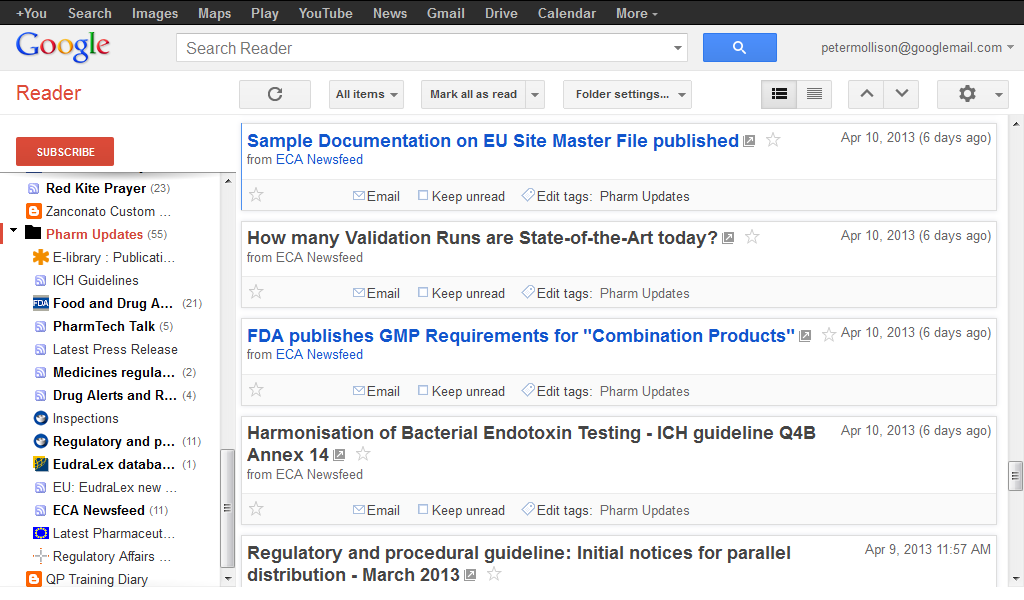
My main tool for monitoring updates is via RSS feeds.  You'll need a RSS reader such as Google Reader to provide a viewable platform for the incoming feeds.  RSS feeds are typically linked to websites and once the story is published the link gets sent straight to your reader.   This provides a useful way of skimming through all your favourite websites without having to trawl through each website in turn.  Most websites will have an orange RSS symbol within their news section.  Clicking on this symbol will provide a direct link for your RSS reader.

Occasionally you will receive updates via RSS before the website has been updated.  For example, the recent updates to the chapters within Eudralex Vol 4 is not (yet) listed on the Eudralex section of the ec.europa.eu website.  Thanks to my RSS reader these updates found their way to me and can easily be retrieved by searching within my RSS reader.  If you were only looking at the Eudralex website you may have missed these crucial updates to GMP.


Google Reader detailing my Pharmaceutical updates section

Google reader is also available as a mobile app which allows you to sync your reader account to your smartphone/tablet for access during those long commutes on the train.  Most RSS readers can also incorporate your favourite blogs which will send new posts to your reader as soon as they are published.

My top sources for RSS feeds:

MHRA
EMA
FDA 
ICH
Eudralex (ec.europa.eu)
European Federation of Pharmaceutical Industries & Associations (EFPIA)
RAPS Regulatory Exchange
GMP Publishing
European Compliance Academy (ECA) 
Pharma IQ
Royal Pharmaceutical Society
World Health Organisation
International Organisation for Standardisation (ISO)


  2.  Email Alerts

Email alerts are also a great way of keeping up to date.  Most of the main players in the Pharmaceutical/GMP arena have email alerts you can sign up to.   The emails can come flying in thick and fast and I would recommend setting up a dedicated email address for this if you don't want your regular inbox becoming inundating and messing up your hectic social life.  

Signing up for the MHRA drug alert emails is particularly useful.  Not only are the alerts emailed instantly but they are a really useful source for potential scenario-based questions and to get an good idea of what types of defects/errors make up the different types of drug alert classes.  The FDA's warning letters (483) provide a great insight into serious GMP inspection findings for sites both within and outside the United States.  

My top sources for Email alerts:

FDA
MHRA
European Compliance Academy (ECA)


3.  Twitter

I am only a recent convert to Twitter but have found it useful for providing information and links to websites & articles that you may not have originally thought of.  Twitter lends itself well to the mobile platforms due to the (mostly) text only interface.

Again, all the main culprits have twitter accounts such as MHRA, EMA, RPS etc but I tend to use Twitter for following specialist individuals as opposed to large organisations.  These specialist individuals usually dont have the resources for setting up RSS feeds or comprehensive email alerts systems and hence I let my Google reader account take care of information from the large organisations.  When you find someone to follow it is always worth looking to see who they are following themselves.  This will likely increase your scope and identify further people/organisations to follow.

These are some of the useful active accounts I'm following:

@PharmaIQ
@QPQuandary
@AlecGaffney
@PharmaNews
@BioPharmIntl
@Inspiredpharma
@PharmTechGroup
@EURlex


3.  Other Social Media & Journals

There are quite a few additional sources available to you.  Facebook, journals, blogs, LinkedIn to name but a few.  I tend not to rely on these for providing updates to relevant GMP/legislation/guidelines.  I've found these sources to be more useful for general information, networking and job hunting!

I still like to occasionally browse some of the high impact journals surrounding subjects that I have a personal interest in.  These include; Cancer Cell, Cell, Nature Cancer Reviews, Science & NEJM.  These obviously wont keep you up to date with the latest GMP developments but will provide background knowledge to scientific progresses in disease states relevant to your particular dosage forms.  This background knowledge may also help prepare you for what is to come in the future with regards to novel treatments - they'll all hopefully need QP certification one day!


Using MindMaps to manage updates

Throughout your QP training there will be a number of important updates that you will need to remember for your viva.  Certainly in the last 6 months there has been enough GMP updates to keep us all busy.  The QP assessors will likely expect you to not just list all the updates but provide detail on updates that are relevant to your current practice.  With each new update you can amend your mindmap to reflect the changes and doing this as you go along should help reduce the burden once you get closer to viva day.

My constantly evolving updates Mindmap. 

The image of my mindmap above shows the outline of all the relevant areas of updates that I feel I should be aware of.  I haven't included FDA updates within my own map as my current area of practice does not include any drugs marketed in the USA.

2nd & 3rd layers of updates mindmap showing GMP updates. 

As mentioned in my previous post mindmaps are a really useful tool for providing layers of details to particular subjects.  GMP updates is a good example of making the most out of mindmaps.  The image above has focused in on GMP updates and the first layer is detailing the relevant years.  I doubt you'll be expected to know the explicit details of updates going back 5 years.  I've only gone back to 2008 because this was the last major update of Annex 1 and Sterile products will be my specialist dosage form.

3rd, 4th & 5th layers of updates Mindmap for the chapter 5 update in 2013.  The layering technique is hopefully clear from the image above. 

Summary

GMP & legislature updates are an important part for both your viva and for your future life as a QP.  We are lucky to live in such an electronic age where all relevant updates can be immediately disseminated throughout the QP community.

Taking advantage of the available tools mentioned in the post should help these updates find you as opposed to you going out hunting for them. 


Study Toolbox Part 1:  The Onion
Study Toolbox Part 2:  Introduction to Mindmaps

Friday, 5 April 2013

What is a Qualified Person?


A Qualified Person (QP) is a legal term described in both European and UK medicines legislation as far back as 1974.  QPs are legally responsible for certifying batches of medicines for sale or supply within the EU.  The QP therefore has tremendous responsibilities for public safety.  QPs typically work within the pharmaceutical industry mainly within quality departments.  Movement into regulatory affairs is a common avenue for QPs wishing for a change.  Other avenues include training, consultancy/contracting or turning to the darkside and joining the ranks of the medicines inspectorate!

Can anyone become a QP?

No, EU legislation has defined the requirements for eligibility for becoming a QP.  EU directive 2001/83/EC, as amended, states within Article 49 that candidates must have a university diploma/degree in one of the following disciplines; pharmacy, medicine, veterinary medicine, chemistry, pharmaceutical chemistry & technology and biology. 

Ok, I have one of those degrees - sign me up!

Not so fast, within the UK QPs must be a member of either the Royal Pharmaceutical Society, Royal Society of Chemistry or Society of Biology.  Membership of one of these bodies ensures that QPs are subject to a professional code of conduct. 

Ok, Ok, I've just graduated and joined one of the relevant professional bodies - now can I join the club?

Hold your horses, there is yet more requirements before you can be named as a QP.   The EU directive states a minimum requirement of at least 2 years practical experience within an organisation authorised to manufacture medicinal products.  This is 2 years full time experience, part time will only be counted pro-rata towards to minimum period.

The nature of EU directives allows some interpretation when transposed into UK Law.  As a result the UK legislation covering medicines (Human Medicines Regulations 2012) provides an exception to the 2 year rule.  Pharmacists are required to have a minimum of 1 year practical experience (biologists and chemists still require 2 years). 

Before you biologists & chemists start moaning, consider yourself lucky you are not German.  In Germany only pharmacists are allowed to be eligible for QP status.

finally, I'm in.....

err, not quite but the end is in sight.  Once you have your relevant degree, practical experience and joined one of the 3 bodies you can submit an application form (assuming your sponsor agrees - I'll write a separate post on this at a later date).  If your application is deemed satisfactory by panel of QP assessors then you will be called to an oral examination or viva.  The viva is your opportunity to show you are worthy of the QP title and involves usually 3 person panel firing questions and scenarios at you for approximately 1 hour.  They assess your answers and either give you a thumbs up or thumbs down. 

The QP assessors are not the final adjudicators in the process.  The final decision of whether you are truly worthy of being assigned QP status lies with the MHRA.  The MHRA will assess your CV and eligibility before naming you on a relevant license.

For those old enough and lucky enough, there was another route to the top.  When the legal basis for a QP came into force around 1975 there was a 'Grandfather clause' to enable those persons already performing the duties of a QP to become officially recognised as such.  They had it tough back then.....

Summary:

QPs certify batches of medicinal products for sale or supply within the EU and their responsibility is reflected by the extensive training requirements of these esteemed positions.